When you buy through links on our articles, Future and its syndication partners may earn a commission.

SpaceX will launch NASA's next exoplanet mission on Sunday morning (Jan. 11), and you can watch the action live.
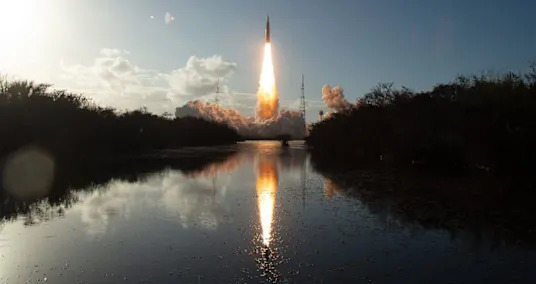
A Falcon 9 rocket carrying about 40 payloads, including NASA's Pandora exoplanet satellite, is scheduled to lift off from California's Vandenberg Space Force Base during a 57-minute window that opens at 8:19 a.m. EST (1319 GMT and 5:19 a.m. local California time).
You can watch it live via SpaceX's website or X account; coverage will begin about 15 minutes before launch.
During its yearlong orbital mission, the 716-pound (325 kilograms) Pandora will study at least 20 known exoplanets using a 17-inch-wide (45 centimeters) telescope, which it will train on the worlds as they "transit," or cross the face of, their host stars from the satellite's perspective.
Such transits cause a small dip in the host star's brightness, which exoplanet hunters have used to great advantage: Most of the more than 6,000 alien planets we know of have been discovered via the "transit method."
Transits also allow astronomers to characterize known exoplanets, especially their atmospheres. Different elements and molecules absorb light at specific wavelengths, so studying the spectrum of starlight that has passed through an atmosphere can reveal a great deal about that atmosphere's composition.
However, such work is complicated by stellar complexity. Star surfaces are not uniform; they often feature patches of varying brightness, like the sunspots that speckle our own star. Pandora will help astronomers account for such complexity, if all goes to plan.
"Pandora aims to disentangle the star and planet spectra by monitoring the brightness of the exoplanet's host star in visible light while simultaneously collecting infrared data," NASA officials wrote in a mission description. "Together, these multiwavelength observations will provide constraints on the star's spot coverage to separate the star's spectrum from the planet's."

Pandora will focus on planets with atmospheres that are dominated by water or hydrogen, agency officials added.
The other three dozen or so satellites going up on the Twilight mission are a diverse group. Among them are 10 of Kepler Communications' Aether spacecraft and two of Capella Space's advanced new Acadia Earth-imaging radar satellites.
SpaceX is no stranger to rideshare missions like Twilight. To date, the company has launched 15 such flights in its Transporter series and four via a different program known as Bandwagon.
Twilight will mark the fifth liftoff for this particular Falcon 9's first stage. If all goes according to plan, the booster will land back at Vandenberg about 8.5 minutes after liftoff.
LATEST POSTS
- 1
 Did we start the fire? A 400,000-year-old hearth sparks new questions about human evolution
 - 2Vote In favor of Your Favored Kind Of Bites
- 3UK to hold fresh pork, other affected Spanish products at border amid African swine fever outbreak
- 4Purchases of iPhone 17 Pro soar across Gaza amid 'limited' humanitarian aid
- 53 Italian City Cars That Outsmarted Regulations and Rivals



- Figure out How to Pick a SUV with Senior-Accommodating Tech Elements
- Telecommute Arrangement: What's Pivotal for Your Efficiency?
- Vote in favor of your Number one kind of juice
- Andrew McCarthy's awe-inspiring image of a skydiver in front of the sun
- German official report: Teen social media ban faces legal hurdles
- From Loner to Force to be reckoned with: Individual Accounts of Change
- 4 Must-Visit bar-b-que Eateries This Year
- Relive NASA's historic Artemis 2 launch to the moon in these stunning photos
- ‘Integral part of our nation’: Herzog visits Franciscan Sisters in Jerusalem ahead of Christmas